
'Three manufacturing sectors can create jobs by the million: Apparel, food, and electronic assembly.' 'Let's talk to them and ask them what it would take to scale by a factor of ten,' suggests Naushad Forbes.

It was touted as a game changer but big-ticket privatisation has been a mixed bag as the government faces unanticipated challenges of lukewarm investor response, employee union agitation and legal hurdles. Prime Minister Narendra Modi's often-repeated statement 'the government has no business to be in business' guided the drawing up of an ambitious privatisation pipeline. While Air India sale succeeded, Bharat Petroleum Corporation Ltd (BPCL) divestment failed.

This was reflected in India Inc's lackadaisical attitude towards sensitising employees on fraud prevention.

Certain clarifications by the GST Council, such as tax rates on ice cream parlours and royalty paid to state governments over mineral rights, may turn out to be contentious and lead to litigation, feel some experts. The council, at its meeting in Lucknow on Friday, had clarified that ice cream parlours will attract goods and services tax (GST). The clarification said these parlours sell already manufactured ice cream and such supply would draw 18 per cent tax.
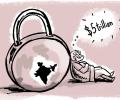
India will need $8 trillion (around Rs 588 lakh crore) of gross capital formation or new greenfield assets to become a $5 trillion (around Rs 368 lakh crore) economy by FY2027, a report said. The report by Deloitte said despite the COVID-19 disruption, FDI inflow into the country provides necessary optimism and display underlying strengths of the Indian economy. In FY2020-21, FDI inflows (including equity, re-invested earnings, and capital) amounted to a record $81.72 billion, 10 per cent higher than the previous financial year, it said.

The government expects onion prices to fall below Rs 40 per kilogram by January from the current average price of Rs 57.02 per kilogram, Consumer Affairs secretary Rohit Kumar Singh said on Monday. Last week, the government banned onion exports till March next year after the retail sales price of the kitchen staple crossed Rs 80 per kg in the national capital and the prices in mandis remained around Rs 60 per kg. To a query on when the onion prices are expected to fall below Rs 40 per kg, Singh said, "very soon... January"

Acquisitions may have played a role in much of the increase.

Campa is set to take on its competition, which pushed it out of the aerated drinks business in the late 1990s, but this time with a new owner - Reliance Industries. Campa's entry comes at a time when aerated drinks as a category is already saturated. But experts say this could give rise to competition in the segment, eventually causing the space to grow.

India's Rs 4.5-trillion fast-moving consumer goods (FMCG) sector was one of the first to bounce back from the lockdown induced blues, reporting a year-on-year (YoY) growth in the October-December quarter last year. That said, the overall consumption figures continue to remain depressed. The FMCG market, which includes daily consumables like branded atta, hand sanitizers, edible oils, shampoos, razors, and so on, recorded 7.3 per cent value growth during the period, while the smartphone market grew by 21 per cent.

'We are looking at the next target which is to be a $1 billion ARR firm in the next 4-5 years.'

Indian companies are likely to shell out an average salary increment of 10.3 per cent in the current fiscal with employees in pharma, health care and life sciences projected to get 12.4 per cent raise, says a survey.

Of the 1,145 offers made this year, consulting firms made up 34 per cent, followed by banking, financial services and insurance, pharma/healthcare, IT/ITeS and FMCG/retail.

The edtech major promised a learning revolution, offering hope to millions of under-educated youth. Now, those dreams are shattered, observes Devangshu Datta.

The government on Friday proposed hiking the securities transaction tax on Futures & Options (F&O) contracts, a move that will increase the trading costs in the derivatives segment as well as help in curbing excessive trades. In the Finance Bill 2023, passed by the Lok Sabha on Friday, the Securities Transaction Tax (STT) on options is proposed to be increased to 0.0625 per cent from 0.05 per cent and on futures contracts to 0.0125 from 0.01 per cent. Analysts opined that higher STT will shore up the government's revenues to some extent and also discourage excessive trading since a large number of retail traders are losing money in the segment.

Work-related stress can impact one's mental health. Which is why Saurabh Tiwari says he's fortunate that his company understands this and is doing whatever it can to help mitigate that stress. "My company provides opportunities according to my interest, and if anyone is feeling stressed or has additional workload, they can talk with their supervisor to resolve it," says the 31-year-old who's working from home for a Bengaluru-based IT firm. Not everyone's as lucky.

...followed by financial services, IT, and sales and marketing.

Insurance behemoth Life Insurance Corporation of India (LIC) is the fourth largest insurer in the world, according to a ranking based on life and accident & health reserves of companies in 2022 by S&P Global Market Intelligence. The state-owned insurer is ranked after Allianz SE, China Life Insurance Company, and Nippon Life Insurance Company. According to the report, LIC's reserves stood at $503.7 billion. Germany's Allianz SE ($750.20 billion), China Life Insurance Company ($616.90 billion) and Nippon Life Insurance Company ($536.80 billion) are the top three insurance companies in the world.

The government has tweaked the income tax laws to make it easier for the new owners of loss-making public sector undertakings (PSUs) to carry forward the accumulated losses and set them off against future profits. This will result in significant tax savings for the new owners if they are able to turnaround operations of the ailing PSU within a few years. This will, in turn, boost the post-tax earnings and returns for the new owners.

A rare bonhomie among three private telecom companies in raising tariffs coming on the back of a bailout package by the government may have helped the telecom sector avert a crisis but the challenges haven't ceased to exist as the industry faces a cash-guzzling task of rolling out 5G networks in the coming months. The sector that provides direct and indirect employment to millions is projected to see Rs 1.3 lakh crore to Rs 2.3 lakh crore of investments in the coming years in creating robust infrastructure and building telecom and network products that have been incentivised by the government through PLI and other initiatives. After years of cut-throat competition and the apex court ruling on payment of past statutory dues left some players in the lurch, billionaire Sunil Mittal's Bharti Airtel and struggling Vodafone Idea almost in tandem raised tariffs, taking the plunge they had long been talking about.

The government has notified a host of procedural changes in the GST rules, including levy of interest for wrongful utilisation of ITC and turnover threshold for filing annual returns for the 2021-22 fiscal. The changes were vetted by the Goods and Services Tax (GST) Council at its meeting last week. With the amendments notified by the Central Board of Indirect Taxes and Customs (CBIC), businesses have also been allowed to make tax payments on the GSTN portal by using IMPS and UPI payment modes.

'What has happened at Byju's is no surprise to anyone.'
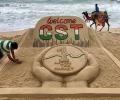
GST collections in February grew 18 per cent to over Rs 1.33 lakh crore in February even as the Omicron wave dented the month-on-month collection momentum. This is for the fifth time in the current fiscal that the Goods and Services Tax (GST) collection has crossed Rs 1.30 lakh crore mark. Also, this is the first time, cess collection has crossed the Rs 10,000 crore mark, signifying recovery in certain key sectors, especially automobile sales, the finance ministry said on Tuesday.
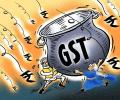
The GST collection in April touched the highest ever level of about Rs 1.68 lakh crore, up 20 per cent from the year-ago period, on improved compliance and recovery in business activity, the Finance Ministry said on Sunday. During the month, 1.06 crore GST returns from GSTR-3B were filed, of which 97 lakh pertained to March 2022. The gross GST revenue collected in April is Rs 1,67,540 crore, of which CGST is Rs 33,159 crore, SGST Rs 41,793 crore, IGST Rs 81,939 crore (including Rs 36,705 crore collected on import of goods) and cess Rs 10,649 crore (including Rs 857 crore collected on import of goods), the ministry said.

A series of steps taken by the government to promote ease of doing business and liberalisation of foreign direct investment norms have helped India receive record FDI inflows so far this year, and implementation of measures like PM Gati Shakti, single window clearance and GIS-mapped land bank are expected to further push investments in 2022. Notwithstanding the global slowdown and the COVID-19 pandemic, total foreign direct investments into India rose to a record $81.72 billion in 2020-21. During April-July this fiscal, FDI (foreign direct investment) into the country increased by 62 per cent to $27.37 billion.

Theft, bribery and corruption, and regulatory non-compliance are the top three frauds

Welcoming the latest round of stimulus announced by Finance Minister Nirmala Sitharaman on Thursday, experts said the measures will support the economic recovery boosting demand, job creation and by providing funds to the MSME and stressed sectors. The fiscal impact of the stimulus is likely to be around 0.25-0.6 per cent of GDP in the current fiscal, they said.

Goods and Services Tax (GST) collections at Rs 95,480 crore in September touched the highest level so far this fiscal, the finance ministry said on Thursday.

The new restriction will be challenging for businesses, as they will have to do regular follow-ups with their suppliers.

At the annual general meeting of Reliance Industries earlier this week, Isha Ambani, director at Reliance Retail Ventures, announced that the company is foraying into the fast-moving consumer goods (FMCG) space. But analysts say that only time will tell if this will lead to a disruption in India's FMCG market. While Reliance Retail's initial strategy is to take its own brands, which it currently sells at its own supermarkets and hypermarkets, to general trade, it is also looking at acquisitions.

More than 70 per cent of Indian youth aged between 15 and 29 can't!

The ministry is of the opinion that there is a need for a rigorous regime for large unlisted companies, in contrast with the current "light-touch" regulation. "There is a defined regime for listed companies, by the Securities and Exchange Board of India (Sebi). "There is a view in the ministry that it needs to look at a framework for large unlisted companies," the senior official said.

Foreign portfolio investors (FPIs) who invest from Mauritius into Indian companies that dole out bonus debentures will get impacted by the tax avoidance provisions on bonus stripping. The FY23 Budget has extended these provisions - applicable only to MFs, so far - to shares and units of REITs, InvITs and AIFs. The move will especially affect large institutional investors who sell original units within nine months after the record date because the loss arising from sale of original units would have to be ignored for the purposes of computing taxable income and cannot be set off against any other capital gain.

Parliament has cleared the Mines and Minerals (Development and Regulation) Amendment Bill, 2023, recently. The objective of the Act is to invite investments from the private sector, including foreign companies, for mining minerals such as lithium and other critical minerals. Other than lithium, some of these minerals were classified as atomic minerals, including beryl and beryllium, niobium, titanium, tantalum and zirconium.
India's GST collection remained above Rs 1 lakh crore for the third month in a row at over Rs 1.17 lakh crore in September, raising expectations that second half of the year will post higher revenues. The tax collections in September on goods sold and services rendered was 23 per cent higher than Rs 95,480 crore collected in September 2020, and 27 per cent higher than Rs 91,916 crore collected in September 2019. The collection in September is the highest in five months since April, when revenue was at record high of Rs 1.41 lakh crore.
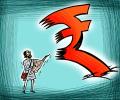
Indian rupee, which earlier this week touched an all-time low, is likely to remain under pressure and may test new levels as a fallout of the US Federal Reserve indicating more interest rate hikes, experts said. The aggressive rate hikes will dampen demand and increase the possibility of a recession in the US. This could accelerate the pace of capital outflows, weaken the rupee and raise the threat of imported inflation.

Experts warn of over-interpreting the numbers and said their sustainability needed to be watched beyond November, says Indivjal Dhasmana.

Byju's is set to go the way of Housing.com and Zilingo. It is only a matter of time. Indeed, the coup attempted by investors will ensure that, says Debashis Basu.

Showing a better trend in remuneration and other benefits for the top-level executives, staff salaries across the board have risen by an average of 50 per cent.

In a show of solidarity, the CEOs of some 40 top American companies have come together to create a global task force to mobilise resources to help India fight the battle against Covid-19.

To future CA aspirants, this is what Sanskruti and Shruti Parolia would like to say: 'The journey is long and tough. Be consistent and persistent. The end result will be rewarding.'
